 Nehemiah
Nehemiah chapter 3 is a list of names, and it is easy to skim. Read it with a map in mind, though, and it turns into something else: a full lap around the wall of Jerusalem, gate by gate, with the name of whoever repaired each stretch. It starts at the Sheep Gate and ends where it began (Nehemiah 3:1, 32).
The circuit, gate by gate
On a map with north at the top, the account runs counterclockwise: west along the north wall, south down the western side, around the southern tip of the city, and back north along the eastern side, above the Kidron Valley. Along the way it names ten gates and two other landmarks, the Broad Wall and the Tower of the Ovens.
 Days 1–4
Section 1 of 12
Sheep Gate
Nehemiah 3:1
- Eliashib the high priest and the priests
- Finish the gate: hang its doors, bolts and bars.
| # | Gate or landmark | Verse | Repaired by |
|---|---|---|---|
| 1 | Sheep Gate | 3:1 | Eliashib the high priest and the priests |
| 2 | Fish Gate | 3:3 | The sons of Hassenaah |
| 3 | Jeshanah Gatealso “old gate” | 3:6 | Joiada and Meshullam |
| 4 | Broad Wallalso “wide wall” | 3:8 | Goldsmiths and perfumers |
| 5 | Tower of Ovensalso “tower of the furnaces” | 3:11 | Malchijah and Hasshub |
| 6 | Valley Gate | 3:13 | Hanun and the people of Zanoah |
| 7 | Dung Gate | 3:14 | Malchijah son of Rechab |
| 8 | Fountain Gatealso “spring gate” | 3:15 | Shallun son of Colhozeh |
| 9 | Water Gate | 3:25-26 | Pedaiah son of Parosh; the temple servants lived nearby on Ophel |
| 10 | Horse Gate | 3:28 | The priests, each in front of his own house |
| 11 | East Gate | 3:29 | Shemaiah, keeper of the east gate |
| 12 | Miphkad Gatealso “gate of Hammiphkad” | 3:31 | Malchijah the goldsmith, then goldsmiths and merchants back to the Sheep Gate |
Translations name some of these differently. The Old Gate is also called the Jeshanah Gate, the Fountain Gate is the spring gate, and the Inspection Gate is the gate of Hammiphkad or the Muster Gate.
North: the Sheep Gate to the Old Gate
The high priest Eliashib and the priests went first. They rebuilt the Sheep Gate, sanctified it and set up its doors, as far as the towers of Hammeah and Hananel (Nehemiah 3:1). It stood close to the temple, and its name probably comes from the sheep brought in for sacrifice.
West of it, the sons of Hassenaah built the Fish Gate, with its beams, doors, bolts and bars (Nehemiah 3:3). Later in the book, men of Tyre are selling fish in Jerusalem (Nehemiah 13:16), which fits a gate named for the fish trade. Next came the Old Gate, repaired by Joiada and Meshullam (Nehemiah 3:6).
Along this stretch the account also mentions the men of Tekoa, whose nobles “didn't put their necks to the Lord's work” (Nehemiah 3:5). The ordinary Tekoites did, and later repaired a second section too (Nehemiah 3:27).
West: the Broad Wall and the Tower of the Ovens
The western side has no gate until the Valley Gate, but two landmarks. Goldsmiths and perfumers repaired the wall “even to the wide wall”, the Broad Wall (Nehemiah 3:8). Further on, Malchijah and Hasshub repaired the Tower of the Ovens (Nehemiah 3:11). This is also where Shallum, a district ruler, worked alongside his daughters (Nehemiah 3:12).
South: the Valley, Dung and Fountain Gates
Hanun and the people of Zanoah rebuilt the Valley Gate and then a thousand cubits of wall, about 450 meters, as far as the Dung Gate (Nehemiah 3:13). That is by far the longest single stretch in the chapter.
Malchijah son of Rechab repaired the Dung Gate (Nehemiah 3:14), at the southern end of the city, likely where refuse was carried out toward the Hinnom Valley. Around the tip, Shallun rebuilt the Fountain Gate and the wall of the pool of Shelah by the king's garden, up to the stairs coming down from the City of David (Nehemiah 3:15).
These three gates are the same ones Nehemiah passed on his night inspection, before anyone knew his plan. He went out by the Valley Gate, on to the Dung Gate and the spring gate, found the way too broken for his animal to pass, and came back the way he had come (Nehemiah 2:13-15).
East: the Water Gate to the Inspection Gate
Up the eastern side, the list gets crowded with houses. Many people repaired the wall in front of their own home (Nehemiah 3:23, 28-29). The temple servants lived on Ophel, near the Water Gate (Nehemiah 3:26). After the wall was finished, the people gathered in the square in front of the Water Gate to hear Ezra read the Law (Nehemiah 8:1-3).
Above the Horse Gate, the priests each repaired in front of their own house (Nehemiah 3:28). Shemaiah, the keeper of the East Gate, repaired his part (Nehemiah 3:29). The last named gate is the Inspection Gate (Nehemiah 3:31), and from there goldsmiths and merchants closed the circuit back to the Sheep Gate (Nehemiah 3:32).
Gates that are not in chapter 3
Nehemiah 3 is not a complete list of every gate. When the wall was dedicated, two choirs walked on top of it, and the route in Nehemiah 12:39 also passes the Gate of Ephraim and ends at the gate of the guard. The Gate of Ephraim appears in Nehemiah 8:16 as well. Chapter 3 names ten gates because it follows the work: these were the places that had to be rebuilt.
Why the list matters
The order shows how the work was organized. The circuit was split into short stretches, each given to a family, a town or a trade, so everyone could build at once. People working in front of their own houses had every reason to build well. That is a large part of how the wall was finished in 52 days (Nehemiah 6:15), which we cover in how long it took to rebuild the wall.
Walk the circuit in the game
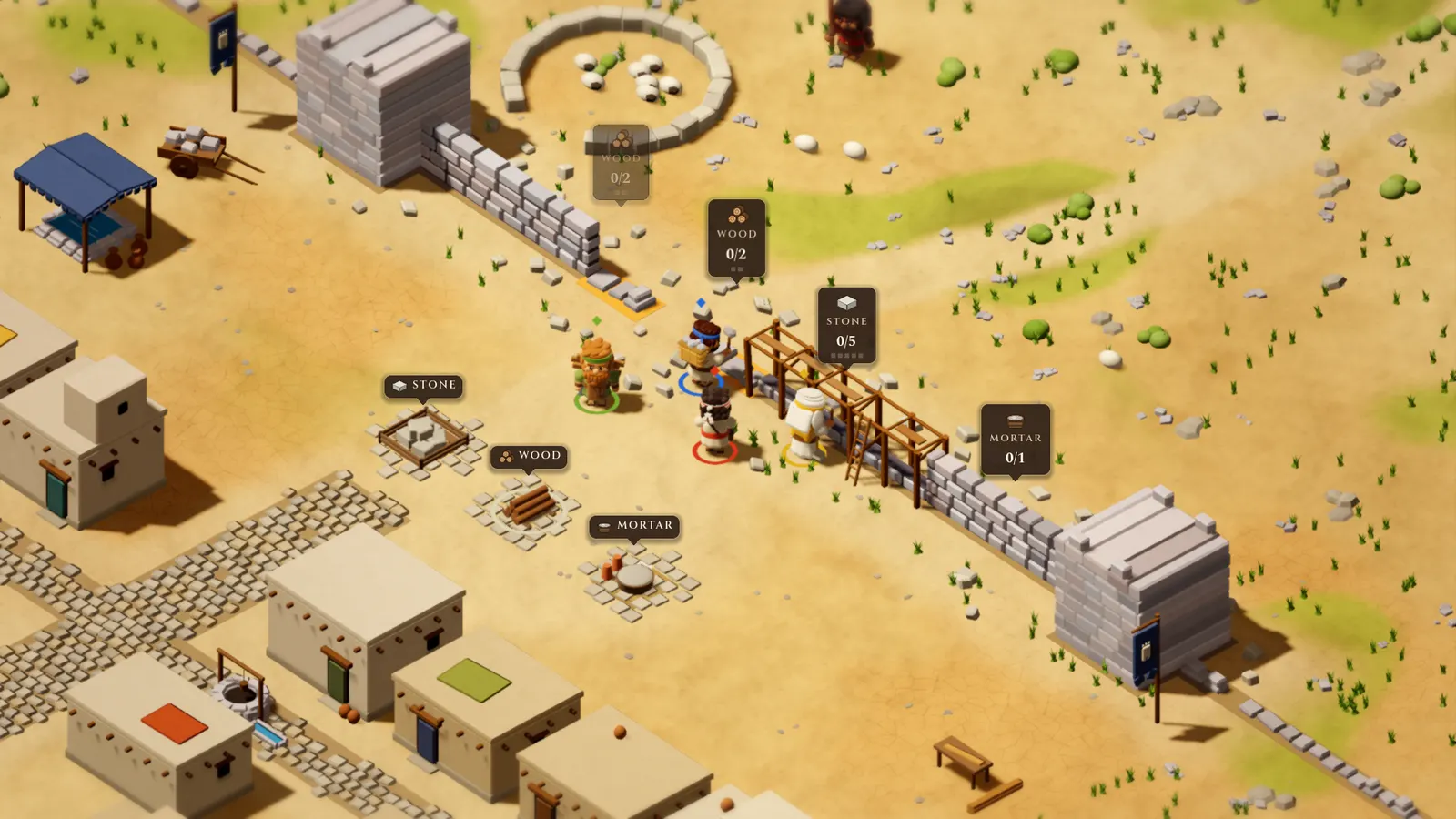
Nehemiah follows this same order. The campaign has 12 sections, one for each gate and landmark above, starting at the Sheep Gate on day one and closing the circuit at the Inspection Gate on day 52. Each section adds something from its verse: heavy beams at the Fish Gate, salvaged stone at the Old Gate, a double-thick wall at the Broad Wall, and messengers calling you down to Ono at the East Gate. The how to play guide lists every section.